The dynamic technological, economic, and social development is one of the most characteristic features of contemporary times. Although this progress brings numerous benefits, it increasingly raises questions about its axiological foundations and long-term consequences for individuals, societies, and the natural environment. In scientific debates and public discussions, the tension between efficiency, innovation, and economic growth on the one hand, and values such as human dignity, social justice, or moral responsibility on the other, is clearly evident.
The conference 'Development without Values? Ethical Challenges of the Modern World' aims to create a space for critical reflection on the relationship between development and the values that should guide it, or even limit it. At the center of the debate should certainly be ethical dilemmas related, among other things, to the development of artificial intelligence and the algorithmization of decision-making, digital transformation and changes in the socio-economic order, as well as today's forms of globalization and new models of capitalism seen from the perspective of the common good.
Certainly, special attention should be devoted to the problem of growing social and economic inequalities and their impact on social cohesion and the functioning of democracy. An important area of reflection should also be the ethical challenges associated with the climate crisis and environmental degradation, phenomena that undermine existing development paradigms and compel thinking in terms of global and intergenerational responsibility.
The conference organizers also invite consideration of whether the dominant models of development lead to the instrumentalization of humans – their work, talents, and aspirations, which sometimes are subordinated to the logic of productivity growth and competitiveness. An alternative to this approach is offered by development concepts focused on well-being, human rights, and the relationship between society and the planet, such as the human development paradigm or sustainable development.
The conference has an interdisciplinary character and invites researchers representing not only business ethics but also broadly understood humanities and social sciences, as well as public policymakers, experts, practitioners, and representatives of social organizations. Its aim would be not only to diagnose the key ethical challenges of the contemporary world, but also to seek normative frameworks and practical solutions that promote responsible, inclusive, and value-based development in the 21st century.
Calendar
| Submission deadline for abstracts: | 31st January, 2027 (250 – 500 words). |
| Submissions without presentation are due by: | 1st March, 2027 |
| Authors will be notified of abstract acceptance by: | 31st March, 2027 |
| Early bird registration ends: | 1st February, 2027 |
| The deadline for conference registration is: | 30th April, 2027 |
The topic is: “Development without values? Ethical challenges of the modern world.” But we also invite all other kinds of contributions in business ethics.
Registration
--- CLICK HERE FOR REGISTRATION ---Fees
Early bird registration ends: 1st February, 2027
| EBEN members (early registration) | PLN 1 550 |
| EBEN members (late registration) | PLN 1 750 |
| PhD students (early registration) | PLN 850 |
| PhD students (late registration) | PLN 1 050 |
| other participants (early registration) | PLN 1 800 |
| other participants (late registration) | PLN 2 000 |
We are pleased to invite doctoral students to participate in our upcoming Doctoral Workshop in Business Ethics on Wednesday, 19th May 2027. The workshop provides an opportunity for PhD candidates to present and discuss their ongoing research with peers and senior scholars in the field, and to receive constructive feedback for advancing their work.
Who should apply?
Doctoral students at any stage of their program working in the broad area of business ethics, including (but not limited to):
- Corporate responsibility and sustainability
- Ethical decision-making and leadership
- Organizational justice and fairness
- Stakeholder theory and practice
- Philosophical foundations of business ethics
Submission requirements
- If you are pursuing a cumulative dissertation: please submit a draft of one article.
- If you are writing a monograph: please submit a proposal or draft chapter.
Benefits of participation
- Expert feedback from established scholars in business ethics
- Peer-to-peer exchange and networking
- Opportunity to strengthen and refine your dissertation project
- Participation at the EBEN Annual Conference on Ethics and new beginnings at the personal, organisational and governmental level
- Participation at a Meet-the-Editor event
Practical information
Date & venue: Wednesday, 19. May 2027 at the Jagiellonian University, Faculty of Management and Communication, prof. St. Łojasiewicza 4, 30-348 Kraków, Poland
Submission terms: 1st March, 2027
Decision is sent out by: 31st March, 2027
Early bird registration ends: 1st February, 2027
Participation fees for the workshop and the EBEN Annual Conference are:
- PhD students (early registration) PLN 850;
- PhD students (late registration) PLN 1,050;
Please send your submission (max. 20 pages) along with a short CV and a copy of your student ID eben2027@uj.edu.pl. We look forward to welcoming you to this workshop and to engaging in fruitful discussions that will help shape the future of business ethics research.
Institutional Organizers
The conference is organised by the Jagiellonian University - Faculty of Management and Social Communication and the European Business Ethics Network.
Organizing Committee
- Magdalena M. Stuss (Jagiellonian University, Krakow, Poland)
- Aneta Kuźniarska (Jagiellonian University, Krakow, Poland)
- Paweł Kozakiewicz (Jagiellonian University, Krakow, Poland)
- Monika Jedynak (Jagiellonian University, Krakow, Poland)
- Michał Michalski (Adam Mickiewicz University, Poznan, Poland)
- Jacek Sójka (Adam Mickiewicz University, Poznan, Poland)
- Halina Zboroń (Poznań University of Economics and Business, Poland)
- Wiesław Banach (Adam Mickiewicz University, Poznan, Poland)
Scientific Committee
- Silvana Signori (University of Bergamo, Italy) - President
- Björn Fasterling (EDHEC Business School, France)
- Leire San-Jose (University of the Basque Country, Spain)
- Eberhard Schnebel (Goethe University, Germany)
- Marjo Siltaoj (Cass Business School, UK)
- Magdalena M. Stuss (Jagiellonian University, Krakow, Poland)
- Monika Jedynak (Jagiellonian University, Krakow, Poland)
- Aneta Kuźniarska (Jagiellonian University, Krakow, Poland)
- Michał Michalski (Adam Mickiewicz University, Poznan, Poland)
- Jacek Sójka (Adam Mickiewicz University, Poznan, Poland)
- Halina Zboroń (Poznań University of Economics and Business, Poland)
Travel
By Plane to Kraków
Kraków Airport (John Paul II International Airport Kraków-Balice) provides regular flights to many European cities and selected international destinations. The airport is conveniently connected with the city centre by rail. Trains run directly to Kraków Główny Railway Station, located just a short walk from the historic centre. The journey takes approximately 20–25 minutes, with departures every 30 minutes. A one-way ticket costs around 16 PLN (approximately 4 EUR). Public Transportation
Public transport in Kraków
Kraków’s public transport system is reliable, affordable, and easy to use. Tram lines 18 and 52 connect the city centre, where most conference participants are likely to stay, with the university campus hosting the conference. A single journey ticket costs 6 PLN (about 1.5 EUR). For visitors planning to use public transport frequently, a 7-day travel pass is available for 56 PLN (approximately 14 EUR).
Venue
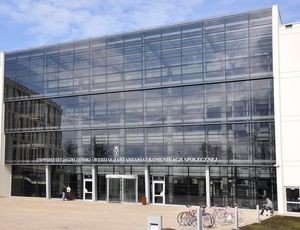
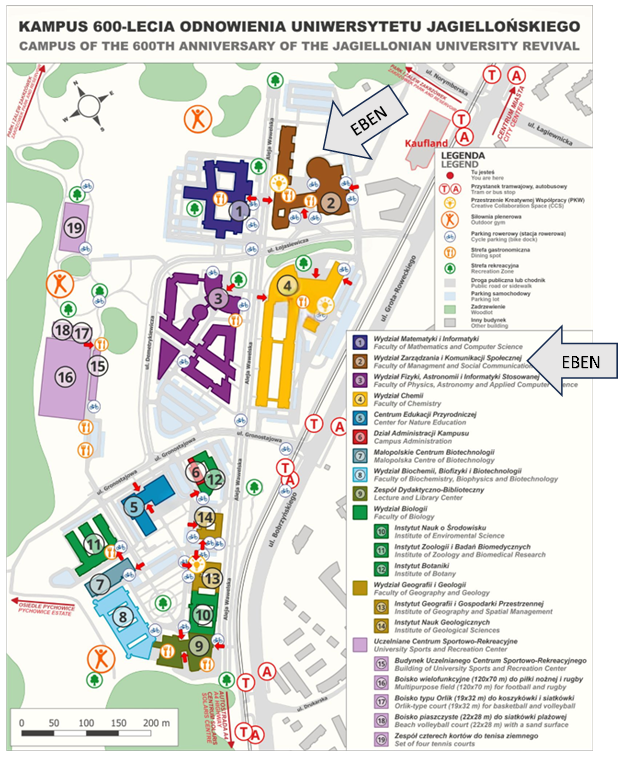
The conference will be in the building:
Jagiellonian University
Faculty of Management and Communication
prof. St. Łojasiewicza 4, 30-348 Kraków, Poland
The Faculty is well communicated with the city center by tram lines 18 and 52, nearest stop is Norymberska.
Accommodation
Hotel closest to conference venue:
- https://convictus.pl/
- www.hotel-bb.com discount code entitling you to a 15% discount on the standard price, code: EBEN2027
About Kraków
Kraków is Poland’s second-largest city and one of the country’s most important historical and cultural centres. Formerly the capital of the Kingdom of Poland, the city has preserved an exceptional architectural and cultural heritage developed over centuries. Thanks to the fact that it escaped large-scale destruction during World War II, visitors can still admire its remarkably well-preserved medieval core.
The Old Town, together with Wawel Castle and the vast Market Square, forms part of the UNESCO World Heritage List. Kraków is also widely recognised as a leading academic destination, with numerous universities and research institutions, including the renowned Jagiellonian University, established in 1364. The city offers a unique combination of historical charm, academic excellence, and contemporary cultural life.
Main attractions: Main Market Square (Rynek Główny): The heart of Kraków’s Old Town and one of the largest medieval squares in Europe, surrounded by elegant townhouses, cafés, restaurants, and landmarks such as St. Mary’s Basilica. Wawel Castle and Cathedral: Situated on Wawel Hill overlooking the Vistula River, this historic complex served for centuries as the residence of Polish monarchs and remains one of the country's most important national symbols.
Kazimierz District: Once the centre of Jewish life in Kraków, Kazimierz is now a lively neighbourhood known for its historic sites, artistic atmosphere, galleries, cafés, and vibrant evening scene. The area gained international recognition as a filming location for Schindler’s List.
Places worth visiting nearby: Visitors staying in Kraków can easily reach the famous Wieliczka Salt Mine as well as the Auschwitz-Birkenau Memorial and Museum, both among the most significant heritage sites in Poland.
Link to individual tour bookings: https://qr.link/LCxp1S
Jagiellonian University
Faculty of Management and Communication
prof. S. Łojasiewicza 4, 30-348 Kraków, Poland
email: eben2027@uj.edu.pl